


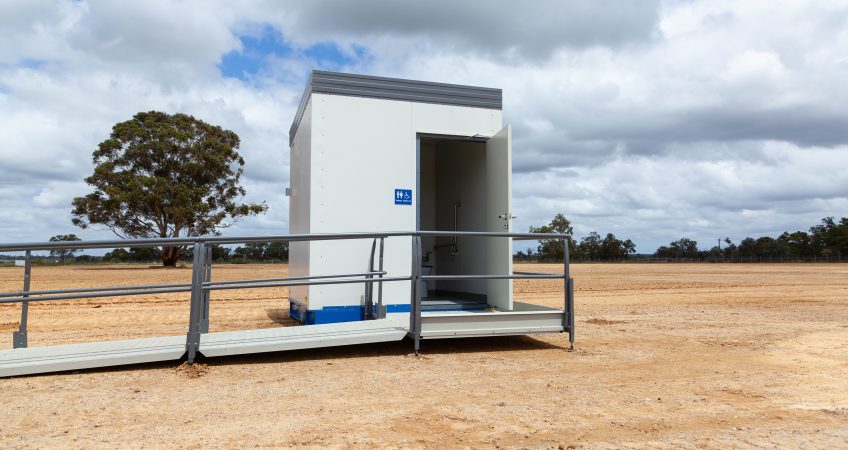
Not every project starts with accessibility in mind. But many end up needing it addressed in some way.
The short answer is not every site automatically requires one. The longer answer is that many do under council conditions, building codes, contract requirements, or workplace expectations.
It’s easy to assume that hiring an AS1428-compliant toilet ticks the box. But in reality, accessibility compliance is about the full setup. In this guide, we break down when a disabled access toilet is required, what that requirement triggers, and how to avoid costly compliance mistakes before your site goes live.
When is a Disabled Access Toilet Required?
The requirement for an accessible toilet isn’t automatic across every site. It depends on how the space will be used, who will access it, and what approvals apply. Below are the most common scenarios where accessibility becomes mandatory or strongly expected.
Public Events
If your event is open to the public, accessibility is rarely optional.
Local councils often require accessible amenities as part of event approvals. The number of units required usually depends on expected attendance, event duration, and whether alcohol is being served. Accessibility obligations also fall under broader disability legislation, which requires reasonable access for all members of the community.
If patrons, performers, vendors or staff include people with mobility limitations, you must provide suitable facilities. In most permitted public events, at least one compliant accessible toilet is required.
Construction Sites
Construction sites aren’t always public-facing, but accessibility can still apply.
Large worksites with mixed workforces may require accessible amenities to support inclusivity and workplace obligations. Government-funded projects and Tier 1 contractors often include accessibility requirements within their contracts. If the site office is accessible, the amenities typically need to be as well.
It’s also becoming standard practice across major projects to ensure facilities are suitable for all workers, not just the majority.
Commercial & Development Sites
Display homes, sales offices, community developments and mixed-use projects often trigger accessibility requirements.
If members of the public, clients or investors are visiting the site, accessible amenities may be required under the National Construction Code or local planning conditions. Even temporary setups used during construction phases can fall under these requirements if they are accessible to the public.
The Difference Between Product Compliance and Site Compliance
When it comes to accessible toilets, there are two separate compliance layers.
- Product Compliance
- Site Compliance
Product compliance refers to the unit itself.
An accessible toilet must meet AS1428 standards, which set the rules for layout, circulation space, door widths, grab rails, fixture heights and usability. In short, the design must allow a wheelchair user or person with limited mobility to use the facility safely and independently.
You can learn more about how our disabled accessible toilets and showers meet accessibility needs in our detailed guide. We also explain how Instant Toilets & Showers complies with AS1428 standards if you want a technical breakdown.
Site compliance, on the other hand, relates to everything around the unit.
This includes:
- The pathway leading to the toilet
- Ground stability and surface condition
- Ramp gradient and landing areas
- Clear space at the entry
- Overall positioning on site
You can have a fully AS1428-compliant unit. But if it’s installed on soft ground, without a compliant ramp, or with restricted access, the overall setup may not meet requirements.
Compliance Extends Beyond the Toilet
Once an accessible toilet is required, the obligation extends beyond simply hiring the right unit. The surrounding setup must also support safe and independent access.
Here’s what that typically involves.
Placement
The unit should be positioned in a logical, easy-to-reach location. It should sit along the same accessible route as the rest of the amenities. Placing it on uneven ground, behind tight corners or away from main access paths can create compliance issues fast.
As part of our service, we review site plans before delivery to help determine the most practical and compliant position.
Access Pathways
The pathway leading to the unit must be firm, stable and slip-resistant. Grass, sand and loose gravel might seem fine during setup, but they often shift under heavy traffic or weather.
If someone cannot safely reach the entrance, the overall installation may not meet requirements, even if the toilet itself does.
We regularly guide clients on ground preparation and temporary surface solutions to avoid last-minute problems.
Ramp Configuration
If the unit sits above ground level, a compliant ramp system is required. That means:
- Correct gradient
- Stable landing areas at the top and bottom
- Sufficient width for wheelchair access
- Secure, non-slip surfaces
Improvised ramps or steep temporary setups often fail inspection. The ramp must be designed to work with the unit.
We supply ramp systems designed to integrate properly with our accessible units. That way, product compliance and site compliance align.
Surface Stability
The toilet must sit on a firm, level base. If it shifts, rocks or settles unevenly, door clearances and ramp safety can be compromised.
Before installation, we help determine whether compacted ground, a prepared base or a concrete pad is needed. Getting this right early avoids repositioning, reinstallation and unnecessary delays.
Speak to Us Before You Set Up
Accessibility is easier to plan from the start than to fix later.
At Instant Toilets & Showers, we supply disabled accessible toilets for hire across Western Australia, and disabled accessible toilets for sale nationwide. More importantly, we help make sure the full setup is done properly, from placement to surface stability.
If you’re organising an event or managing a site, speak to us today.
Call 08 9406 6600 or contact us online and we’ll help you get it sorted without the runaround.